7 signs your dog needs professional training in Metro East
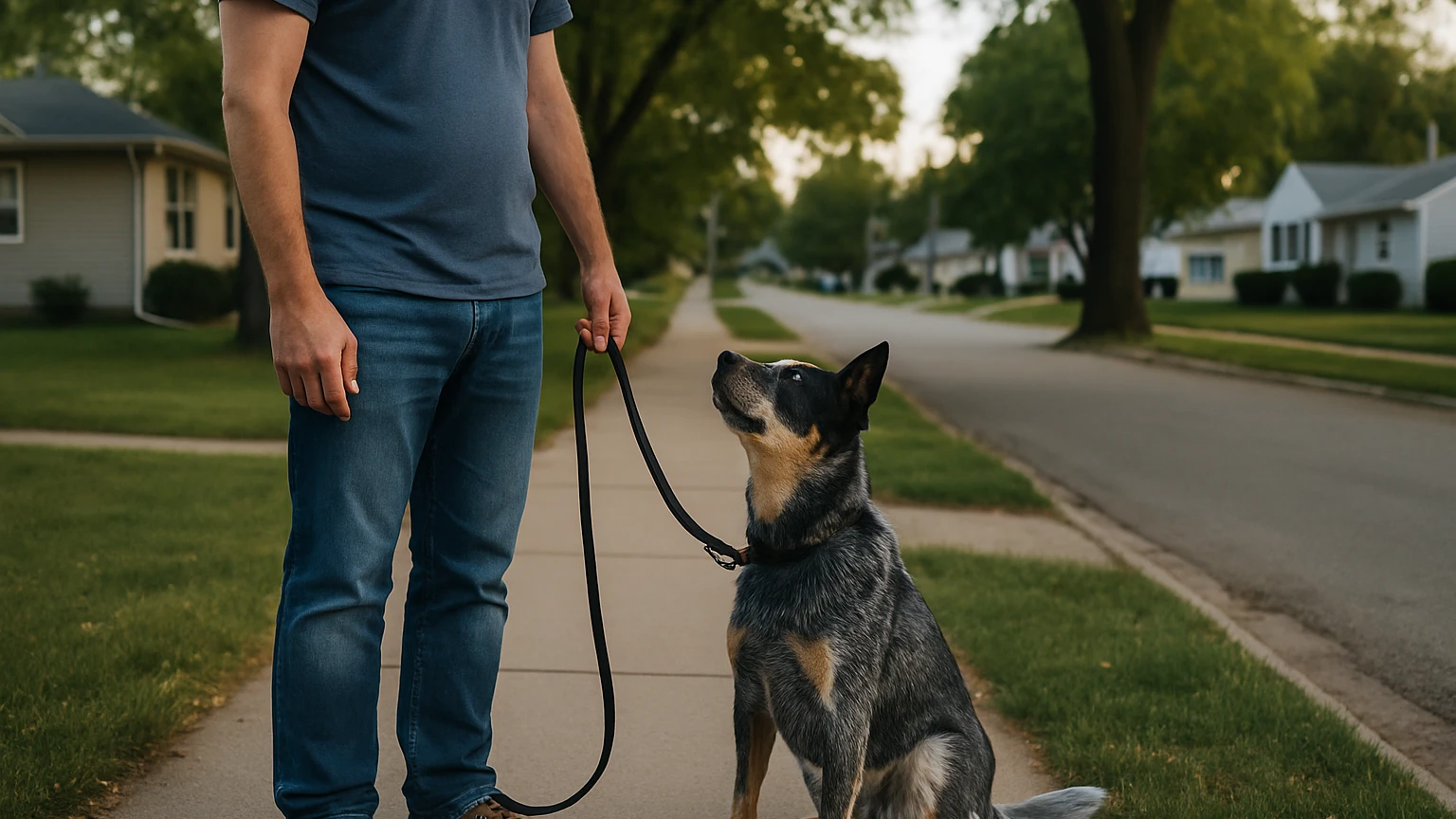
You've been working with your dog for months. Maybe you watched YouTube videos or tried the advice from the vet. Your dog still pulls on the leash, still barks at other dogs, still won't listen when you need them to. You're wondering if this is normal or if you should call someone who does this work for a living.
Here's what we see every week in Fairview Heights. Dogs with good owners who've done everything they could think of, but the problems aren't going away. These are the seven signs that tell you it's time to bring in a professional.
Your dog pulls you down the street on walks
Your dog drags you to every tree, lunges at passing dogs, and makes walks feel like a workout you didn't ask for. If your dog is dragging you down the street, lunging at every person that passes, or has made your walks into a workout that you did not request, you have a lead work problem. This isn't about your dog being strong. It's about your dog not understanding what the leash means. You're both frustrated, and walks that should be enjoyable have turned into something you dread. A professional can teach your dog leash manners in a structured setting, then show you how to maintain it when you get home.
Your dog shows aggression toward people or other dogs
Dogs exhibit aggression by growling, barking, or trying to attack other people and/or pets. If your dog has growled, snapped, or nipped at someone even once, this is not something to wait out. Aggression is not something the average person should try to fix because it often makes the aggression worse. Aggression escalates fast, and the risk to other people, other dogs, and your own dog is real. This is the moment to call a professional trainer who has worked with aggressive dogs before and knows how to address the root cause.
Your dog has severe anxiety when left alone
Anxiety can cause behavioral issues in dogs like barking excessively, peeing and pooping indoors, and aggressiveness. If your dog destroys furniture, howls for hours, or paces and pants when you leave the house, that's separation anxiety. Only professionals should handle separation anxiety; it is a serious psychological disorder. Your vet and your behaviorist should work closely together to figure out which medication and training combination your dog needs to live a calmer life. This isn't a behavior problem you can fix by leaving the TV on or buying more toys. It's a real condition that needs real intervention.
Your dog ignores basic commands you've already taught
If your dog consistently fails to respond to basic commands, it's a clear sign that structured training is needed. You taught your dog to sit, stay, and come. They did it fine in the kitchen for treats. Now you're at the park and they act like they've never heard the words before. That's a generalization problem. Your dog learned commands in one setting but didn't learn to apply them everywhere. A professional trainer works with your dog in multiple environments and teaches them that the rules apply no matter where they are.
Your dog can't calm down around visitors or at the door
Dogs who bark excessively at the doorbell, jump on every visitor, or can't settle when someone knocks often need professional training for impulse control. "Reactivity to someone coming into the apartment, excessive barking at the doorbell/knocking, excessive jumping, and not being able to calm down are all signs that may indicate a need for professional training," according to professional trainers. If your dog loses control every time someone knocks, jumps on every visitor, or barks for ten minutes straight when the doorbell rings, that's a threshold problem. Your dog doesn't have the tools to settle when excitement hits. Professional training teaches impulse control and gives your dog a calm default behavior instead of chaos.
Your dog shows fear or anxiety around other dogs
Anxiety in dogs can have a number of triggers, but the most common causes include fear, separation, and aging. If your dog hides, growls, or tries to escape when another dog comes near, that's fear-based anxiety. This limits where you can take your dog and makes every encounter stressful for both of you. Noise sensitivity, the most common fear-based anxiety, affects about 32% of dogs, according to one large study. Generally, this type of anxiety stems from a lack of experience or knowledge of the fearful trigger. Socialization training with a professional exposes your dog to other dogs in a controlled, safe way and builds confidence instead of avoiding the problem.
You're exhausted and thinking about rehoming your dog
When walks are a fight, visitors stress you out, and you can't remember the last time you enjoyed time with your dog, you're past the DIY stage. Many owners reach this point and think the only option is to give the dog away. That's not true. Most behavior problems can be fixed with the right training approach, and a professional knows how to get there faster than you can on your own. Board and Train programs let a trainer work with your dog daily in a structured environment, then transfer those skills back to you so the changes stick at home.
What happens when you call a trainer in Metro East
When you reach out to a professional dog trainer in Fairview Heights or the broader Metro East, here's what you can expect. First, an assessment. The trainer asks about your dog's history, the specific problems you're dealing with, and what you want to change. We need to understand your dog's history, temperament, drives, behavioral issues, and your goals before we design a program. Then the trainer recommends a plan. That might be private sessions where the trainer works with you and your dog together. Or it might be a Board and Train program where your dog stays with the trainer for one to four weeks and learns new behaviors in a focused setting.
At Marmon Family Dog Training, we send detailed videos after every session. You see what we worked on, what your dog learned, and what to practice at home. That's how the training sticks. Your dog doesn't behave only for the trainer. You learn how to lead your dog so the changes last.
Ready to fix the behavior problems?
If your dog is showing any of these signs, waiting won't make it better. High-energy dogs, anxious dogs, dogs who won't listen, they all need structure and clear guidance from someone who knows how to teach it. Board and Train programs at Marmon Family Dog Training work with dogs in Fairview Heights, Edwardsville, Glen Carbon, Collinsville, and the rest of the Metro East. You get a dog who listens, stays calm, and makes daily life enjoyable again. Get started with a training assessment.